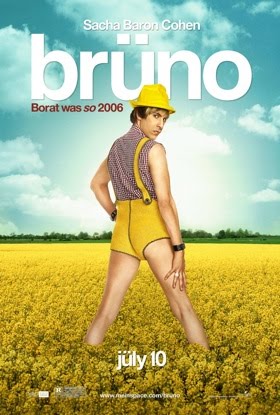
Brüno (2009)

Saturday, 29 August 2009, 9:47 pm | Comments (0)

BrünoThe phenomenon of the difficult second album is alive and kicking in Brüno, Sacha Baron Cohen's follow-up to the brilliant (and brilliantly titled) Borat: Cultural Learnings of America for Make Benefit Glorious Nation of Kazakhstan. But while Brüno doesn't recapture the magic of watching Cohen's hapless Kazakhstan reporter navigate conservative America, it's often hilarious, which is more than can be said for most comedies that wind up in cinemas.

Brüno Gehard is Cohen's third creation from Da Ali G Show. In the guise of a fish-out-of-water documentary à la Borat, Cohen sends the extroverted gay Austrian fashionista to America with one goal: to become famous. In our current celebrity-soaked climate, it's a ripe target for satire and Cohen milks it wonderfully. "I'm going to be the biggest Austrian since Hitler," Brüno proclaims.

What follows is essentially a series of sketches/stunts/pranks loosely strung together by Brüno's pursuit of fame and his assistant's assistant's (no typo there) romantic pursuit of Brüno.

In perhaps the film's most cringe-worthy scene (or at least the most cringe-worthy scene that doesn't involve talking male genitalia), a parade of mothers spruik their babies to Brüno in an effort to have their children feature in a photo shoot. Shockingly, the parents show no qualms about their children potentially having liposuction, wearing Nazi uniforms or appearing crucified as long as their child has a shot at stardom. As an diatribe against fame, Brüno frequently hits a bull's-eye.

Of course, Brüno's other target is prejudice. It's an attack that's only partly successful as Cohen's character obviously embodies all the gay stereotype characteristics that the film itself would aim to stamp out. Fortunately, Cohen's unwitting co-stars are well-picked, including a gobsmacking sequence in which US Republican presidential candidate Ron Paul reacts horribly to Brüno's none-too-subtle passes.

Comparisons to Borat are inevitable given Brüno would never have been made were it not for the surprise box office success of the former picture. This follow-up is a much more uneven film, chiefly for the greater proportion of staged set pieces featured. However, Cohen's knack of nailing those stunts in which he would have had just one chance to do so is consistently impressive. This is never more apparent than during Brüno's joint interview with a Palestinian politician and a former Mossad agent, as well as in a remarkable separate encounter with an alleged terrorist leader.

Cohen's slapstick pratfalling is also a joy to behold. A sequence in which Brüno shows up at a fashion show in Milan while wearing a velcro suit is hilarious in its simplicity.

Brüno's crass, controversial and confrontational humour will obviously not appeal to all, but there are more than enough laughs here to justify a watch for fans of Borat's satirical stunt comedy.

Public Enemies (2009)

Sunday, 23 August 2009, 11:17 am | Comments (4)

Public EnemiesThere's something oddly unengaging about Michael Mann's Public Enemies that keeps the film from achieving greatness. Instead, it's merely good. With the director of Heat and Collateral (we'll overlook that sketchy Miami Vice remake) at the helm, it's disappointing that this tale of John Dillinger, one of history's most infamous criminals, isn't the bona fide classic it had the potential to be.

An adaptation of Bryan Burrough's Public Enemies: America's Greatest Crime Wave and the Birth of the FBI, 1933-43, Mann's film sees Johnny Depp take on the role of Dillinger with a cool, restrained performance that truly sells the character as a real person. It's the central performance Public Enemies needed, given the script itself is rather light on character development; despite clocking in at nearly two-and-a-half hours in length, the film wells too often on plot at the expense of character.

Elsewhere, Christian Bale lends his trademark gruffness to Melvin Purvis, the FBI agent tasked with hunting down Dillinger and his gang, while Marion Cotillard is Billie Frechette, whose romance with Dillinger is sadly underdeveloped.

The real standout, though, is Billy Crudup (last seen all blue and naked as Dr Manhattan in Watchmen) who brings J. Edgar Hoover to life in a minimal amount of screen time.

Stylistically, Public Enemies is a mixed bag. The film is shot in digital which, while visually impressive, is seemingly at odds with the period setting. It's also quite a claustrophobic picture, with Mann often choosing to rely on tight shots to convey a sense of intimacy with the characters; this is at the expense of a feel for the era, which one doesn't get a sense of until some way into the film.

Thankfully, the picture does gather steam as the FBI closes in on Dillinger and his gang – Public Enemies' denouement is as strong as the rest of the film should have been.

One area that scores a direct hit is the film's sound – the Tommy Gun has never sounded as vivid and powerful as in Public Enemies. Each bullet fired is accompanied by a violent crack. If only the rest of the film were as sharp.

Life on Mars (2006-2007)

Thursday, 13 August 2009, 7:49 pm | Comments (3)

Life on MarsFor those of you wondering whether the experience of enduring Transformers: Revenge of the Fallen had turned me off popular culture, fret not. To detox, I've decided to splurge on all the critically-acclaimed telly I missed over the last few years while I was travelling the world, having life-shaping experiences and all that.

The first DVD box sets to land in my shopping basket? BBC's Life on Mars, the time travel/cop show with a premise so balmy it shouldn't work, let alone work so brilliantly.

The excellent John Simm is Sam Tyler, a Manchester police officer who is hit by a car in 2006 and wakes up in 1973. With no idea as to how or why he is living in the past, Sam struggles to fit in with the archaic, corrupt and thuggish 1970s Manchester police force led by Philip Glenister's eminently quotable Gene Hunt.

Tyler's time warp dilemma is mostly a subplot on the show, simmering in the background of each week's fresh, '70s-set police procedural. It's a time when forensic science is a developing field, when suspects and witnesses are treated with equal contempt and when it's perfectly acceptable to halt a murder investigation on account of it being "beer o'clock".

It's testament to the sheer quality of Life on Mars' that at no point does the concept ever feel naff. Jokes about the past and present are sly and subversive without ever seeming too cute; "There will never been a woman Prime Minister as long as I have a hole in my arse," bellows the sexist, racist, alcoholic, homophobe Hunt, who still remains likeable thanks to Glenister's commanding performance.

Dean Andrews as the boorish Ray Carling, Marshall Lancaster as the likeable Chris Skelton and Liz White as love interest Annie Cartwright are all perfect for their parts, but the real focus is wisely kept on Tyler and Hunt; their relationship represents a fascinating contrast between the morals and values of the 1970s and the present day.

Life on Mars is rich on nostalgia, truly capturing the essence of the seventies – the soundtrack is amazing (led by David Bowie's dizzying title track) and the cinematography drenched in all those browns and yellows commonly associated with the decade. This vivid detail of the 1970s constantly plays on Sam's mind, as he fights off voices and visions that suggest he's actually gone insane rather than back in time.

Both seasons deliver a pitch-perfect cocktail of intrigue, humour, action and drama through their highly successful meshing of the science fiction and crime genres. Thanks largely to the strengths of the show's two main actors, Life on Mars also succeeds in being strangely affecting; I challenge any other viewer not to share Sam's mixture of emotions each time he hears a voice beckon to him from the present day.

The programme's creators chose to follow the great British tradition of ending a show at the top of its game, and while Sam's predicament remains almost as intriguingly ambiguous at the end of the show as it was at the start, the finale is perfectly satisfying.

(As an aside, don't get Life on Mars confused with the gratuitous US remake, the finale of which sounds as awful as it is different from that of the UK version.)

If I sound like I'm gushing, it's because I am. Life on Mars is one of the finest shows of the decade. Thoughts on the show's sequel – the 1980s-set Ashes to Ashes, which recently premiered on ABC1 – will be here in the coming weeks.

Transformers: Revenge of the Fallen (2009)

Sunday, 26 July 2009, 4:35 pm | Comments (1)

Transformers: Revenge of the FallenUp until last week, I thought I understood popular culture. I knew reality television would never produce anyone but absolute cretins. I believed celebrity gossip to be a driving force behind the spread of mankind's stupidity. And I accepted no film would ever bludgeon my senses like 2005's Stealth, the Jamie Foxx actioner about a talking plane that turns evil.

And then I saw Transformers: Revenge of the Fallen and suddenly the whole world unravelled before my very bleeding eyes.

Where to start? Perhaps by pointing out that the film's robots (and I'm including the so-called humans in this category for reasons that become clearer with each chunk of moronic dialogue mumbled between explosions) are as soulless, boorish, lumbering, clunky, hulking and unnecessary as the film itself.

Granted, this is a franchise based on a toy line (and an inane one at that) and the first film could only be considered passable in a guilty, check-your-brains-at-the-door kind of way, but my God, Revenge of the Fallen is dumb, even by Transformers standards.

It's pointless dissecting the acting, casting, music, cinematography or direction, as all are as subtle as a cannonball to the face. Quite simply, it's a film where the only thing that's special are the effects, and even those are little more than a forgettable mishmash of pixels.

There's a scene towards the end of the film where, for reasons too moronic to explain, a Decepticon is seen climbing one of Egypt's Great Pyramids. As the camera pans up to reveal the robot, the audience is treated to a bird's-eye view of a pair of giant wrecking balls clanging together. Transformer testicles. Proof positive Transformers: Revenge of the Fallen is utter bollocks.

At least I still have the undeniable, unquestionable, irrefutable assumption that no film this vapid will ever become a box office hit. Oh.

24: Season 7 (2009)

Saturday, 11 July 2009, 5:35 pm | Comments (1)

24: Season 7Spoilers for 24: Season 7

After succumbing to a touch of the swine last week, and being faced with the horrific prospect of watching daytime television, I figured it was the perfect opportunity to catch up on real-time torture-fest 24, which I'd somehow neglected about a third of the way through its seventh season.

Having painfully watched one of my favourite shows jump the shark in its sixth year, I had hoped Day Seven would mark a triumphant return to form. Sadly, this season was little more than a mixed bag.

First, the pros, led by Annie Wersching's Renee Walker, one of Jack Bauer's most worthy counterparts. If 24's audience were combined into a single character on the show, Walker would be it. Initially disgusted by his controversial and brutal methods, Walker is unable to deny that Bauer gets results. In a season of fumbled character arcs, hers is the most authentic, and her final scene points to a genuinely interesting future for the character.

Walker's increasingly conflicted morals, in addition to President Allison Taylor's strong anti-torture policy, provided a surprisingly weighty analysis of the merits and disadvantages of torture.

Speaking of President Taylor (Cherry Jones), she proved herself to be 24's third best president ever (let's be honest: no one will ever top David Palmer or Charles Logan). Even lumbered with an iffy subplot involving the President's daughter ordering a hit on one of the season's main baddies, Jones ensured the Taylor was one of the most balanced and down to earth characters on the show. I look forward to seeing more of her next season.

Props, too, to Will Patton and, in particular, Jon Voight, for giving us two of 24's best villains. Voight lent to Jonas Hodges a kind of gravitas not seen on the show since Dennis Hopper served up a nice big leg of ham in season one.

Sadly, though, Day Seven was still plagued by the kind of clumsy, contrived plotting that's marred several of the show's earlier seasons. Key among these was Tony's resurrection and subsequent character motivations. Sure, 24 has never been an exercise in character studies, but when Jack confronts Tony during the season finale and tells him that his late wife Michelle would never have approved of his vengeful actions, it only served to highlight how absurd his character arc has become.

Oh, and don't get me started on Kim Bauer's far-fetched airport antics. Even though Elisha Cuthbert is so hot it makes my eyeballs burn, it's simply painful to watch her encounter misfortune absolutely everywhere she goes. It's like watching a Wile E Coyote sketch... whenever she appears, you know there's trouble brewing.

Once again, though, it falls to Kiefer Sutherland to keep the whole damn thing together. The man never gives anything less than 110 percent to his performance as Jack Bauer, and his apparent inability to age makes him all the more convincing in the role. His slow yielding to the effects of the bioweapon that was the season's central MacGuffin gave his character a much-needed dose of humanity, even though he will be predictably revived in the hours following the season finale.

Ultimately, though, the season was plagued by some clumsy, stop-start plotting and an underdeveloped conspiracy arc that was never fully realised. With season eight rumoured to be the show's last, here's hoping the sun sets on a better Day.

Free Agent (2009)

Saturday, 4 July 2009, 6:41 pm | Comments (1)

Free AgentThey say you shouldn't judge book by its cover, but the sleek, polished, retro UK dust jacket of Jeremy Duns' debut thriller Free Agent perfectly captures the superb novel lying within.

Free Agent's slow-burn opening chapter (which can be read on the publisher's website) is punctuated by a shocker of a twist that sets the tone that this is no ordinary spy thriller. You can leave any preconceptions about glossy, straightforward Bondian escapades at the door; Free Agent is a bold and refreshing take on the familiar spy genre.

Set in 1969, Free Agent is the first in a proposed trilogy of novels featuring Paul Dark, an MI6 agent whose complicated past suddenly returns to haunt him. When a defecting KGB colonel promises to deliver information to the British about a traitor in their ranks, Dark discovers that a career-changing classified mission he undertook during the final days of the second World War was not all that it seemed.

Dark's mission takes him to Nigeria during the height of the Nigerian Civil War, a rich, untapped setting for a spy novel. Duns paints a vivid picture of the brutal conflict, fleshing out his novel with well-researched chunks of history. Each page drips with atmosphere, as Duns transports his readers to Nigeria's seamy sixties underbelly.

The ace in Duns' hand, though, is his central character. Paul Dark is a fascinating, morally ambiguous protagonist, who remains conflicted by his past allegiances, crimes and loves. Free Agent is told in the first person, providing the reader with a natural insight into the character's actions.

To say much more would be spoiling what is a terrific spy thriller built on tight, fast-paced plotting and genuinely surprising twists. Free Agent's quasi-cliffhanger ending points toward another superior spy novel in Free Country. A must-read for fans of the spy genre.

“I will be missed.”

Thursday, 2 July 2009, 12:15 pm | Comments (0)

The Today Show's Richard Wilkins made the big-time this week when his embarrassing coverage of the supposed death of Jurassic Park star Jeff Goldblum was featured on The Colbert Report.

Goldblum was shown the cringe-worthy piece of journalism on Colbert's show and concluded he must be dead after all, before proceeding to eulogise himself.

Great stuff, but a sad indictment on the state of journalism. In an age of websites, blogs and social media, where anyone can spread falsehoods as swiftly and as accurately as a game of Chinese whispers, it's truly a rum state of affairs when these sick hoaxes aren't researched before appearing as fact on national television.


The Colbert ReportMon - Thurs 11:30pm / 10:30c
Jeff Goldblum Will Be Missed
www.colbertnation.com
Colbert Report Full EpisodesPolitical HumorJeff Goldblum

Naturally, the whole charade prompted Media Watch's Jonathan Holmes to give Wilkins a well-deserved bollocking on air.

Meanwhile, talk show host Jimmy Kimmel hit the street with the question everyone's been asking: where were you when you found out Jeff Goldblum was still alive?


All original content is Copyright © 2009 by popular culture... etc. | Firebug Theme by Blog Oh! Blog | Converted to Blogger Template by ThemeLib.com